
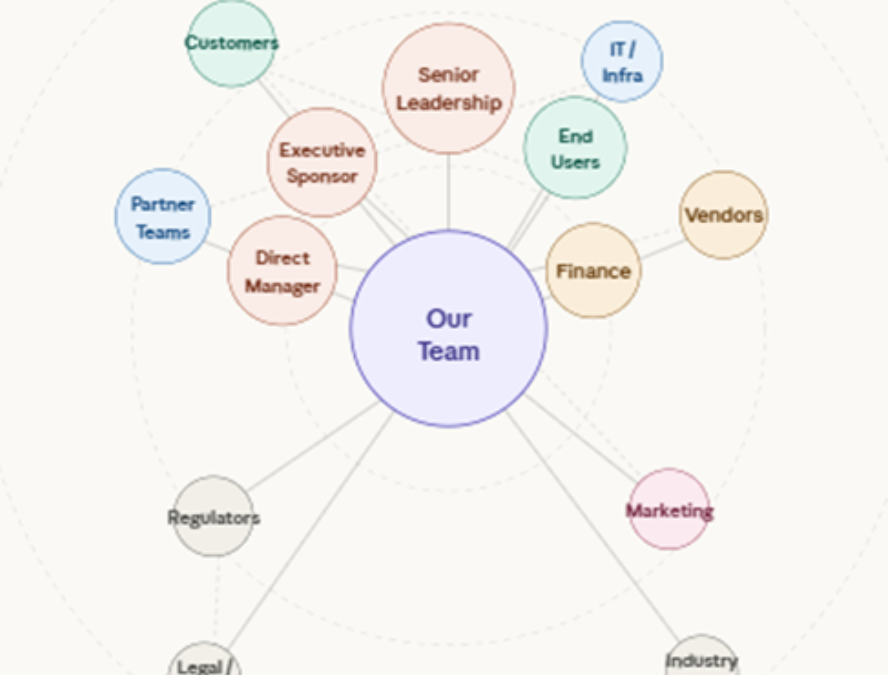
Most teams work hard. They prepare for meetings. They align on goals and strategy (or try to). They tackle the big decisions and try to move the things forward. And still, something doesn’t quite land. Silos persist. Stakeholders feel underserved. The same tensions resurface in different forms. Work is happening, but the results aren’t.
Here’s the truth most don’t say out loud: the problem usually isn’t the individuals. It’s the frame.
Conventional approaches to team development tend to treat the team as a contained unit. Work on the relationships inside the room. Improve communication. Run a personality profile. Build trust over a ropes course. These aren’t bad things. But they are incomplete. They solve for the interior of the team while largely ignoring the ecosystem the team exists within.
Coaching your team as a system takes a fundamentally different view. And if your leadership team is serious about impact, it’s worth understanding the difference.
The Team As a System Within a System
The way to frame any team is to see it as a complex adaptive system. The core premise of this view is deceptively simple: your team doesn’t exist in isolation. It is a living system, embedded within a larger organizational system, which is itself embedded within an even larger stakeholder and market ecosystem.
Professor Peter Hawkins, Emeritus Professor of Leadership at Henley Business School and Chairman of Renewal Associates, has spent decades building and refining his methodology, which he calls Systemic Team Coaching® (STC). In his foundational framework, he argues that high-performing teams don’t just function well internally; they are relentlessly oriented toward creating value for the wider system they serve. He uses “five disciplines” to map team capabilities, from the team’s mandate and internal dynamics all the way out to stakeholder relationships and continuous adaptation (Hawkins, P., Leadership Team Coaching, 4th ed. Kogan Page 2021).
Whether you use Hawkins’ model or others that take a similar approach, what this means in practice is a team coach who works with your team as a complex adaptive system doesn’t just facilitate better meetings. They observe how the team operates as a system, looking for what patterns repeat, what gets avoided, what tensions go unnamed. And they work with those patterns over time, both when the team is together and when its members are apart.
How is Coaching the Team as a System Different from Team Building?
This distinction matters more than many leaders realize. Even excellent team building is an event. It generates energy, creates connection, and can surface important interpersonal insights. But it doesn’t fundamentally change how a team operates within its environment.
The Academy of Executive Coaching (AoEC), co-founded by John Leary-Joyce, a pioneer of STC alongside Hawkins, defines the difference clearly. Team building helps teams in the early stages of formation; it develops interpersonal connection and cohesion. Coaching a team as a system, by contrast, is a sustained process that addresses the team’s collective purpose, its internal dynamics, its stakeholder relationships, and its capacity to lead change in the wider business. (Leary-Joyce, J. & Lines, H., Systemic Team Coaching, AoEC Press, 2018.)
One of the key distinctions Leary-Joyce emphasizes is that the team leader with their team members are coached collectively with attention to how they show up in the context of their shared accountability. This is not group coaching of individuals. It is coaching the team as an entity.
Put simply: team building lights a spark. Coaching a team as a system rewires its circuits.
The Coach Looks for Patterns, Not Just Problems
One of the defining features of coaching a team as a system is what the coach actually pays attention to. In a traditional consulting or facilitation engagement, the focus is usually on a specific issue: a conflict to resolve, a strategy to align, a communication breakdown to fix. While useful, it is limited.
A systemic coaching approach in a team setting uses a wider lens. The coach observes interactions in live meetings and looks for recurring patterns: who speaks and who doesn’t, what topics get deflected, how the team responds to challenge, whether decisions stick or quietly dissolve after everyone leaves the room. As the Odgers leadership practice describes it, the coach approaches the work through multiple lenses — from the individual, to interpersonal dynamics, to team-level patterns, to the team’s relationship with its stakeholders, to the broader organizational environment.
David Clutterbuck, Visiting Professor at Henley Business School and co-founder of the European Mentoring and Coaching Council, frames this through his work on complex adaptive systems thinking. In his 2024 research on levels of coaching complexity, he notes that the most significant issues facing teams are not linear; they are complex and systemic. Traditional coaching models, focused on individuals or isolated team processes, address symptoms. Systemic approaches work at the level of cause. (Clutterbuck, D., Engaging with Complexity in Team Coaching, 2024.)
What this means for your team: the coaching intervention isn’t a one-off diagnosis. It’s an ongoing, evolving partnership that deepens as patterns become visible.
Stakeholder Engagement Is Not a Side Task – It’s the Point
Here is where many teams get stuck. They work hard on what happens inside the team, while treating stakeholder engagement as a separate agenda item … something for the CEO to manage, or a communication task for the COO.
A systems approach reframes this entirely. For example, coaching a team to improve its communication is not simply about connecting better with each other. It is about the team’s collective responsibility to understand, engage with, and co-create value for all key stakeholders, including customers, employees, investors, community, and beyond. The team doesn’t just report to these stakeholders; it serves them together.
Hawkins’ global consultancy describes this shift clearly: traditional team coaching centers on the team as an isolated unit; coaching your team as a system challenges the team to become outward-looking and purpose-driven, continuously learning from and with its environment. (www.renewalassociates.co.uk)
For middle-market companies, this is not a luxury perspective. When your team operates in sync with what its key stakeholders actually need rather than what they assume they need, the results show in performance, retention, and organizational agility.
What Does a Systems Map Reveal That a Slide Deck Cannot?
One of the practical tools of the systemic approach is systems mapping, a technique for visualizing both the task systems and relational systems your team operates within. Who are the key stakeholders? What are the feedback loops? Where are the dependencies? Where is there misalignment between what the team believes and what the system actually requires?
This kind of mapping isn’t an academic exercise. It’s a mirror. It shows the team where it’s been operating with its attention pointed inward and where the real levers of influence and value creation actually live. It reveals blind spots that no performance review or strategy retreat is designed to surface.
The Business Case Is Getting Clearer for the Team as a System
The evidence for sustained team-level interventions continues to grow. Research published in Training Magazine notes that coaching leadership teams as complex adaptive systems delivers measurable quantitative financial performance, lower cost per leader compared to individual coaching, and measurable improvements in leadership competencies over time. Organizations using structured frameworks have reported retention improvements of 15–30% in coached cohorts and significant gains in cross-functional collaboration.
Dr. Catherine Carr, a leading practitioner in the field and co-author (with Peter Hawkins) of Team of Teams Coaching (Kogan Page, 2025), has consistently emphasized that the ROI of systemic work comes not just from what the team does differently, but from how it thinks differently: as a collective, within a context.
The Invitation
If your team is navigating rapid growth, persistent misalignment, or the recurring sense that every meeting moves things forward and yet nothing fundamentally changes, you may be solving for the symptoms while the system hums along unchanged.
When you work with a systemic team coach, it doesn’t fix your team. It helps your team develop the awareness, the practices, and the stakeholder relationships to fix itself and to keep evolving as the landscape shifts.
That’s not a soft outcome. That’s a competitive advantage.
Want to Explore Systemic Coaching for Your Team?
Let’s talk.
I help leaders build high-performing teams. If your team needs help, schedule a free strategy session with me.
Or head over to my team’s page to learn more about how I help team leaders like you build a powerhouse team.
And keep leading with clarity, courage, and curiosity.